“All that glitters is not gold” - William Shakespeare - The Merchant of Venice

A new paper from the group appeared today in the Royal Society journal Interface

Jordan TM, Partridge JC, Roberts NW. 2014 Disordered animal multilayer reflectors and the localization of light. J. R. Soc. Interface 11: 20140948 link 


We see brilliantly coloured animals everywhere: from jewel-like gold beetles, to fish that appear as streaks of silver. Metal-like they may seem, but animals cannot make metal films. Instead, they arrange layers of transparent tissues of variable thicknesses to create iridescent colours and silvery mirror-like reflections. But how does this work? In this paper we demonstrated how a ubiquitous physical phenomenon, Anderson localization, provides a universal explanation for many of the dazzling coloured and silvery reflections we see in the natural world.

Abstract:

Multilayer optical reflectors constructed from ‘stacks’ of alternating layers of high and low refractive index dielectric materials are present in many animals. For example, stacks of guanine crystals with cytoplasm gaps occur within the skin and scales of fish, and stacks of protein platelets with cytoplasm gaps occur within the iridophores of cephalopods. Common to all these animal multilayer reflectors are different degrees of random variation in the thicknesses of the individual layers in the stack, ranging from highly periodic structures to strongly disordered systems. However, previous discussions of the optical effects of such thickness disorder have been made without quantitative reference to the propagation of light within the reflector. Here, we demonstrate that Anderson localization provides a general theoretical frame- work to explain the common coherent interference and optical properties of these biological reflectors. Firstly, we illustrate how the localization length enables the spectral properties of the reflections from more weakly disordered ‘coloured’ and more strongly disordered ‘silvery’ reflectors to be explained by the same physical process. Secondly, we show how the polarization properties of reflection can be controlled within guanine–cytoplasm reflectors, with an interplay of birefringence and thickness disorder explaining the origin of broadband polarization-insensitive reflectivity. 


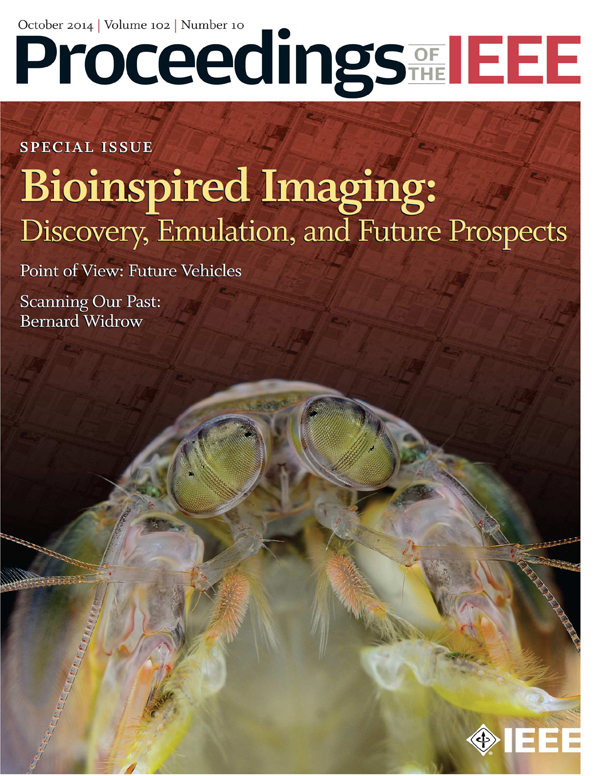
Two new papers and a cover from the group

Two new papers in Proceedings of the IEEE have just come out - both on the common theme of biological inspiration in future imaging technologies.


Roberts, N.W., How, M.J., Porter, M.L., Temple, S.E., Caldwell, R.L., Powell, S.B., Gruev, V., Marshall, N.J., and Cronin, T.W. Animal Polarization Imaging and Implications for Optical Processing. Proceedings of the IEEE 102(10), 1427-1434, 2014.

Biologically inspired solutions for modern-day sensory systems promise to deliver both higher capacity and faster, more efficient processing of information than current computational approaches. Many animals are able to perform remarkable sensing tasks despite only being able to process what would be considered modest data rates and bandwidths. The key biological innovations revolve around dedicated filter designs. By sacrificing some flexibility, specifically matched and hard-wired sensory systems, designed primarily for single roles, provide a blueprint for data and task-specific efficiency. In this paper, we examine several animal visual systems designed to use the polarization of light in spatial imaging. We investigate some implications for artificial optical processing based on models of polarization image processing in fiddler crabs, cuttlefish, octopus, and mantis shrimp.


Powell, S.B., Gao, S., Kahan, L., Charanya, T., Saha, D., Roberts, N.W., Cronin, T.W., Marshall, J., Achilefu, S., Lake, S.P., Raman, B., Gruev, Bioinspired Polarization Imaging Sensors: From Circuits and Optics to Signal Processing Algorithms and Biomedical Applications. V. Proceedings of the IEEE  102(10), 1450-1469, 2014.

In this paper, we present recent work on bioinspired polarization imaging sensors and their applications in biomedicine. In particular, we focus on three different aspects of these sensors. First, we describe the electro–optical challenges in realizing a bioinspired polarization imager, and in particular, we provide a detailed description of a recent low-power complementary metal–oxide–semiconductor (CMOS) polarization imager. Second, we focus on signal processing algorithms tailored for this new class of bioinspired polarization imaging sensors, such as calibration and interpolation. Third, the emergence of these sensors has enabled rapid progress in characterizing polarization signals and environmental parameters in nature, as well as several biomedical areas, such as label-free optical neural recording, dynamic tissue strength analysis, and early diagnosis of flat cancerous lesions in a murine colorectal tumor model. We highlight results obtained from these three areas and discuss future applications for these sensors.


A new funded PhD to start early 2015

New ways of seeing the world: Using the polarization of light to enhance visual contrast and object visibility

A main theme of the research in the Ecology of Vision lab is to understand how animals use the polarization of light to their advantage.  Animals use polarization for secret channels of communication, a way of breaking camouflage and for seeing further in scattering visual environments. 

Polarization information can propagate further than intensity of colour information through scattering media, such as turbid water or dust in the air. We have shown some animals (fish and larval dragonflies) can use their polarization vision to improve underwater visibility by cutting out polarized scatter. This is much the same way as we cut out polarized reflections by using Polaroid sunglasses. At Bristol, we use a polarization camera system to film the polarization information in our visual environment.

We currently have a funded PhD place on offer starting early 2015 to work on applying animal inspired principles of seeing polarization information to polarization image processing.  There are three principle aims for this PhD project:

1) To quantitatively understand the propagation of polarized light and object contrast enhancement in both scattering and low light level visual environments.

2) To develop a computational framework for how animals use polarized light to de-scatter and de-haze a visual scene.

3) To create new ways of polarization image processing for contrast enhancement in airborne / underwater visual search. 

This PhD is restricted to UK students and is funded by EPSRC and an Industrial CASE award from DSTL.

The successful candidate should have a background in computer vision and image processing and a strong interest in biology. If you are a student (MSc or final year Undergraduate) with an excellent academic track record from a top-rank institution, and would like more information, please email nicholas.roberts@bristol.ac.uk  or check http://www.ecologyofvision.com

To apply, please follow the instructions on

http://www.bris.ac.uk/prospectus/postgraduate/2014/apply/


CLOSING DATE for applications is 4pm on 7th Nov 2014. A short list of candidates will be drawn up after this date for interview.